Theses





Kovács Árpád › 2026 › Supervisor: Horváth LeventeThis thesis examines the value crisis among young men of Generation Z from a sociological, psychological, and practical theological perspective. The study explores why young men born between 1995 and 2009 are experiencing an unprecedented mental health crisis characterized by depression, anxiety, purposelessness, and withdrawal from the real world. Drawing on Krisztián Steigervald's generational research, as well as the works of Jonathan Haidt, the thesis analyzes the consequences of growing up in a digital world: smartphone addiction, sleep disorders, attention fragmentation, the harmful effects of social media and video games, the role of pornography, and the disappearance of "third spaces." It highlights the long decline of men in education, the "failure to launch" phenomenon, and the reduction in risk-taking behavior. The thesis defines the concept of value, criticizes postmodern relativism, and identifies absolute moral standards within the Christian worldview.
›Practical theologyNagy Bence Dávid › 2026 › Supervisor: Ősz Sándor ElődThis paper summarizes the life of a 20th-century Transylvanian Reformed pastor who was born under Hungarian rule and lived under Romanian rule. He grew up as a war orphan and, after choosing to study theology, embarked on a career in the ministry. He spent the longest period of his ministry in Pankota, Arad County, but also served as an assistant pastor in Szalárd and Nagyszalonta, and as a deputy pastor in Bősháza prior to his retirement. Due to his religious activities, he was sentenced to 20 years in prison and forced labor, but was eventually released early thanks to a pardon. His accounts reveal that his love for God was the driving force behind his determined effort to share the Gospel with everyone. Based on what we can see from the surviving documents, it appears that he truly loved even his enemies. One of the most unique sources in this paper is Sándor Szilágyi's autobiography, in which he described his experiences in the years following his imprisonment.
›Church historyValki Gergő Sándor › 2026 › Supervisor: Somfalvi EditIn this paper examines the church-image and attitude toward the church among the 14-16 age group, focusing on the youth of the Crasna (Kraszna) Reformed Parish. The research is rendered timely by the fact that this adolescent generation constitutes both the present and the future active membership of the congregation. This life stage is also characterized by the most intense period of self-discovery and a partial distancing from the community.
The thesis consists of two main sections: a theoretical and a practical part. The theoretical section clarifies the theological concept of the church in the light of confessions and statutes and analyzes the psychological characteristics of adolescence alongside the opportunities for religious education. The practical section presents the diverse programs offered by the congregation, describing their specific characteristics and produced, as well as the responses provided by the youth.
›
Practical theologySikó Anita Andrea › 2026 › Supervisor: Balogh CsabaThe Book of the Prophet Jeremiah contains four visions that are generally accepted by scholarly consensus: 1:11–12; 1:13–16; 24:1–14; and 38:21–23. This thesis examines the origin, structure, and possible interpretations of these visions, with particular attention to identifying and analyzing elements that indicate visionary experience. The book also contains several other passages that include vision-related elements, namely: 4:23–28; 11:18–23; 13:1–11; 25:15–38; 23:19–20/30:23–24; and 4:13–18. These disputed passages are also examined in the thesis. In this context, I summarize scholarly opinions regarding their literary classification and possible interpretations. This makes it possible to see which elements support the interpretation of these passages as visions and which arguments have been put forward against such an understanding. The concluding section of the thesis presents a synthesis based on the four visions accepted by scholarly consensus.
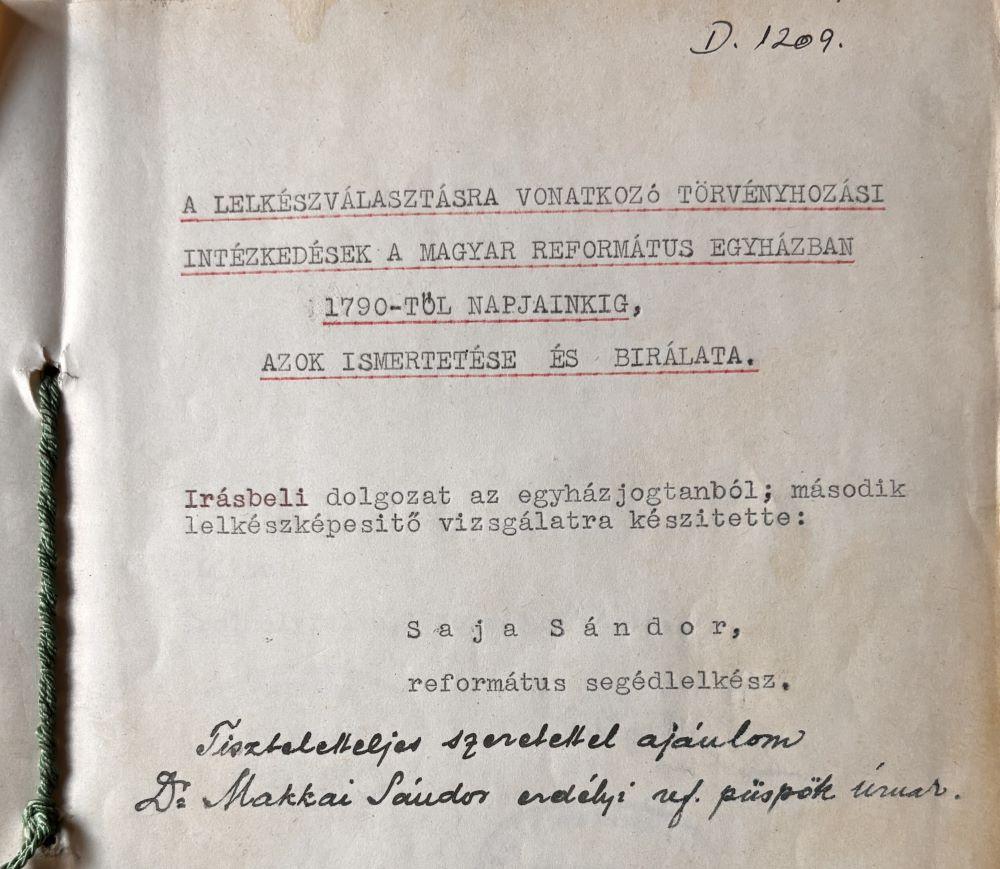
›Old TestamentBesenyődi Attila › 2026 › Supervisor: Ősz Sándor ElődThis thesis presents and analyzes the inventories of six congregations: Mezőmadaras, Mezősámsond, Mezőkölpény, Székelykövesd, Mezőfele, and Mezőcsávás. These inventories originate from 1687 and are preserved in the oldest matricula of the Maros Reformed Diocese. The thesis begins with an overview of the formation of the Maros Reformed Diocese, addressing the spread of the Reformation in the region as well as the ecclesiastical and social conditions of the period. This is followed by a brief presentation of the history and historical background of the congregations under examination. The analysis of the sources reveals the economic situation and property holdings of the individual congregations. The inventories provide information about real estate and land owned by the congregations, as well as objects used in ecclesiastical life, including communion vessels, textiles, and books.
›Church historyVass Lehel › 2026 › Supervisor: Balogh Csaba, Kállay DezsőIn New Testament textual criticism, a broad consensus has emerged that the Markan shorter ending, the scene of Jesus' agony (Luke 22:43–44), and the story of the adulterous woman (John 7:53–8:11) did not originally belong to the text of the Gospels. Because the traditions underlying these passages are early, the most recent critical editions of the Greek New Testament print them in the main text. On the basis of an analysis of these early traditions, the present study contends that (1) the conclusio brevior was appended to the Gospel according to Mark as part of the Vorlage for the earliest known Old Latin translation; (2) the Agonia Christi was inserted into the "Western text" of Luke's Gospel as an anti-Gnostic polemic; and (3) the Pericope Adulterae was incorporated into John as an anti-Novatianist polemical discourse via the Greek exemplars underlying the Vulgate.
›New TestamentPap Miklós › 2026 › Supervisor: Horváth LeventeThis master's thesis examines the ego concepts of the New Age and postmodernism, weighing them against the gospel and the Christian confessions. The research explores the birth of the modern self, focusing on how humanity shifted from following the divine order to creating its own identity. The thesis critiques the unstable, fluid identity of postmodernism, as well as the self-worshipping ego of the New Age movement. Based on Scripture and Reformed confessions, the work contrasts these modern secular ideas with the biblical worldview. The research concludes that true human dignity and stability are not found in absolute independence, but exclusively in a restored identity, redeemed in Christ and reconciled with the Creator.
›Systematic theologySzéles László › 2026 › Supervisor: Kovács SándorThe thesis examines the posthumous memory and cult of Mózsa Berde, a 19th-century Unitarian benefactor. Known for his austere frugality during his lifetime, Berde's bequest of his vast fortune to the church, primarily for educational purposes, generated profound institutional reverence. The core of the research analyzes the memorial speeches delivered with the "Berde goblet" at Chief Council dinners between 1899 and 2025. The study demonstrates how these rhetorical acts transformed Berde into a moral compass for the community, elevating him as an ideal of self-sacrifice and duty. The narratives evolved over time, particularly after the loss of the estate following the 1921 Romanian land reform. Consequently, the focus shifted from nation-building and material wealth to his spiritual and moral legacy. Ultimately, the thesis highlights how this dynamic cult has continually reinforced Transylvanian Unitarian identity amidst shifting historical and political contexts.
›Church historyThe Image of God among Individuals Struggling with Addiction and Its Formation during Rehabilitation
Vass Áron-Levente › 2026 › Supervisor: Horváth LeventeThe primary aim of my thesis is to examine how and in what direction the image of God held by individuals struggling with addiction changed during rehabilitation in various rehabilitation centres. I also investigated whether this change influenced their therapy, especially in relation to abstinence. To answer these questions, I conducted 21 interviews, taking into account the complexity of the image of God. The study focuses on childhood images of God, family and religious socialization, changes in the image of God during active addiction, and the new image of God formed during rehabilitation. It also examines which activities, experiences, and institutional teachings contributed to this transformation. The results show that, in Christian rehabilitation centres, the formation of the image of God is often connected to changes in self-understanding, guilt, hope, and the relationship to abstinence.
›Practical theologyÚjlaki Vivien › 2026 › Supervisor: Éles ÉvaThis thesis examines the confrontations between the Sadducees and Jesus. In the course of my research, I first compile and analyze data drawn from various sources, examining the relevant works of Flavius Josephus, their occurrences in the New Testament, as well as passages concerning them in rabbinic literature. I then synthesize the collected data and, on this basis, seek to develop a comprehensive picture of the Sadducee group.
›
New TestamentVass Lehel › 2026 › Supervisor: Balogh Csaba, Kállay DezsőIn New Testament textual criticism, a broad consensus has emerged that the Markan shorter ending, the scene of Jesus' agony (Luke 22:43–44), and the story of the adulterous woman (John 7:53–8:11) did not originally belong to the text of the Gospels. Because the traditions underlying these passages are early, the most recent critical editions of the Greek New Testament print them in the main text. On the basis of an analysis of these early traditions, the present study contends that (1) the conclusio brevior was appended to the Gospel according to Mark as part of the Vorlage for the earliest known Old Latin translation; (2) the Agonia Christi was inserted into the "Western text" of Luke's Gospel as an anti-Gnostic polemic; and (3) the Pericope Adulterae was incorporated into John as an anti-Novatianist polemical discourse via the Greek exemplars underlying the Vulgate.
›New TestamentDániel Márton-Levente › 2026 › Supervisor: Visky Sándor BélaThis thesis examines Leibniz's Theodicy and its problem: how the existence of evil can be reconciled with the perfection of God. It explores the interrelation of metaphysical, physical, and moral evil with divine goodness, omnipotence, omniscience, and providence. The thesis pays attention to the theory of possible worlds and to Leibniz's claim that God chose the best among all possible worlds. The thesis also analyzes the relationship between divine foreknowledge and freedom, focusing on the distinction between certainty and necessity, as well as determination and coercion. According to Leibniz, actions may remain free despite having determining reasons, provided that they arise from the agent's will and inner motivations. The study concludes that Leibniz's system offers a coherent attempt to preserve divine goodness, responsibility, and providence simultaneously. Nevertheless, it does not resolve the problem of suffering.
›Systematic theologyAlbert Szabolcs › 2026 › Supervisor: Kató Szabolcs FerenczNumerous textual records have preserved the father-son structure of scribal families in the ancient Near East and Egypt. This phenomenon was likely present in Israel as well, and is particularly reconstructable in the activities of the Shaphanide family, which formed the core of the Deuteronomistic circle (2Kgs 22–25; 2Chr 34–36). The chronological framework of the Book of Jeremiah coincides with the period of Josiah's reign and the final days of Judah (Jer 1,1–3). This book features names belonging to the Shaphanide family with considerably greater frequency than in the reform texts, raising the possibility that those names are Jeremiah's close relatives. I attempted to substantiate the possibility proposed in this paper on the basis of Jeremiah's Confessions (11:18–12:6; 15:10–21; 17:14–18; 18:18–23; 20:7–18). However, the analysis neither confirms nor refutes the hypothesis.
›Old TestamentFlorea Magdalena-Melinda › 2026 › Supervisor: Horváth LeventeAddiction is one of the biggest social, health and spiritual problems of our time, and it affects a lot of teenagers. This thesis looks at how the Church can help young people avoid addiction. The research is based on reviews of the literature, along, with some practical experience. The thesis explains what addiction is, what kind of addiction exist, and how it connects to medicine, addiction studies, psychology. It also looks at the important role of the family during adolescence, and at the different forms of substance and behavioral addictions. One section deals with the theological side, showing that the Bible also speaks about addiction. The findings suggest that the Church has an important role, especially in prevention, but also in noticing supportive communities. The thesis concludes that church-based prevention works best when it is done together with professional helpers.
›Practical theologyBerekméri Virág › 2026 › Supervisor: Papp GyörgyThis thesis examines the representation of transcendent beings in the Jewish literature of the Second Temple period, with special attention to 1 Enoch and the Book of Jubilees. Its aim is to explore how ideas about angels, fallen beings, demons, and heavenly mediators developed in connection with the historical, religious, and cultural changes of the period. Using religio-historical, text-critical, and comparative methods, the study analyzes Babylonian, Persian, and Hellenistic influences, as well as the figures of the Watchers, Asael, and Mastema. It concludes that these traditions do not indicate a weakening of monotheism, but rather form part of theological reflection on the origin of evil, divine justice, and human responsibility. The texts under discussion played a significant role in shaping later Jewish and Christian demonological and angelological thought.
›Old TestamentBalogh Zoltán › 2026 › Supervisor: Kállay DezsőThe Epistle of Jude is one of the most complex yet historically marginalized texts of the New Testament. This thesis aims to address the closely interrelated issues of authorship and dating by examining the letter's historical and contentual questions in unity. Utilizing a historical-critical approach, the study integrates literary, theological, and rigorous linguistic-exegetical analyses. Beginning with canon-historical data and the second temple Jewish apocryphal background, the scope is progressively narrowed to the exegesis of core Greek terms in pivotal passages (Jude 3–4; 17–21). The analysis demonstrates that the content of faith appears as an authoritative yet still open apostolic tradition. Through the synthesis of linguistic and theological data, the thesis attempts to provide a well-founded definition of the letter's early ecclesial context and circumstances of composition.
›New TestamentBogya Johanna › 2026 › Supervisor: Somfalvi EditThis thesis examines the extent to which the congregation members' image of God is influenced by the pastor's image of God. Pastors occupy a prominent position within the religious community, and many people regard them as role models in their faith and in their relationship with God. For this reason, pastors bear a heightened responsibility to ensure that their understanding and representation of God accurately reflect reality. In order to make the results measurable, the study first investigates various images of God, including the factors that may give rise to distorted God images, the effects these distortions may have on individuals and their surroundings, and the ways in which a correct understanding of God can be attained. Subsequently, the relationship and interaction between pastor and congregation are analyzed. Based on the synthesis of this information, the empirical research section is developed using a self-designed comparative questionnaire.
›Practical theologyBokor-Imreh Huba › 2026 › Supervisor: Ősz Sándor ElődIn this study, I examined the eighteenth-century aristocratic funerals and the pastoral ministry performed during these ceremonies. My research sought to reconstruct and describe, step by step, the funeral practices of the period, to identify all relevant references in synodal records, canon law, and contemporary diary entries, and to draw conclusions and establish broader patterns based on statistical data derived from the bibliographies of eighteenth-century funeral sermons. Aristocratic funerals of the period were among the most significant events in Transylvanian Reformed society. They provide valuable insights into contemporary culture, social and ecclesiastical dynamics, the theological thinking of reformed ministers, and the traditions of aristocratic burial customs, many of which can be traced back to the Middle Ages.
›Church historyKádár Dávid › 2026 › Supervisor: Horváth LeventeThis thesis examines occultism and exorcism as contemporary challenges for Protestant pastoral care. The study employs an interdisciplinary approach, integrating theological, historical, anthropological, psychological, and pastoral-psychological perspectives. It presents the historical development of exorcism and explores the similarities and differences between Catholic and Protestant practices. Particular attention is given to the Protestant interpretation of demonology, the medical and psychological factors associated with alleged possession phenomena, and the spiritual needs underlying interest in occult practices. The thesis argues that the primary task of pastoral care is not the sensational treatment of demonic phenomena but the provision of biblically and theologically grounded guidance and support.
›Systematic theology, Practical theology